

My book, Jelly Roll Animal Quilts, features more than 40 animal‑inspired projects - quilts, rugs, wall hangings, placemats, mug rugs, and more. Every design begins with precut 2½″ fabric strips, which are sub‑cut into rectangles and transformed into 60° shapes by trimming the corners in a special way.
In this post, I’ll walk you through the basics of cutting and piecing these shapes. These techniques will help you cut accurately, align trimmed corners, and piece your shapes with confidence.

Cutting 60° Shapes
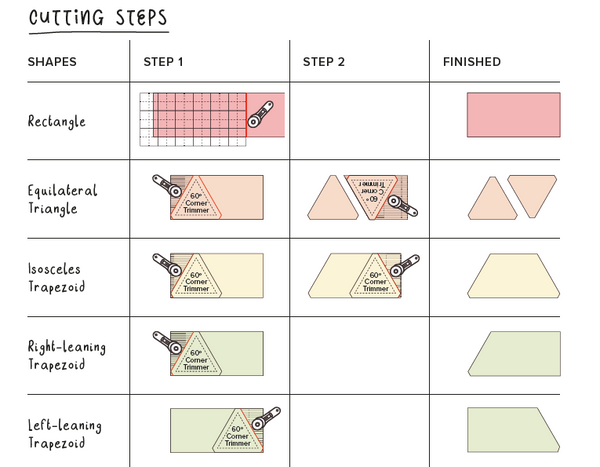
To create the 60° shapes used throughout the book, you’ll trim the corners of your rectangles using a 60° corner trimmer or a ruler with trimmed 60° corners. My go‑to tools are:
- Marti Michell’s 60° Corner Trimmer
- Hex‑N‑More Ruler by Julie Herman of Jaybird Quilts
Whatever tool you choose, avoid rulers with pointed 60° corners. If the point meets the fabric corner, you’ll accidentally trim off the seam allowance and your shape will be too short.
Depending on your project, you can cut the following shapes from 2½″ strips:
- Rectangles
- Equilateral triangles
- Isosceles trapezoids
- Right‑leaning trapezoids
- Left‑leaning trapezoids
Refer to your chosen pattern for the required dimensions and cutting diagrams.
No Special Ruler? No Problem.
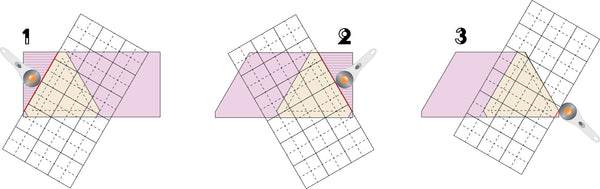
If you don’t have a specialty ruler, you can use the 60° templates included in the book or print THIS FILE at actual size. Cut out two paper templates:
- One for trimming the sides
- One for trimming the corners
Then:
- Tape the first template behind your quilting ruler, aligning the triangle’s side with the ruler edge and the dashed line with the ¼″ mark.
- Tape the second template to the back of the ruler (or a second ruler), aligning the trimmed corner with the ruler edge and the dashed corner with the ¼″ mark.
- Use the first template to cut the sides (steps 1–2), then use the second to trim the corners (step 3).
Tips for Layering Strips Before Cutting
- For symmetrical shapes, place two strips wrong sides together and cut as one.
- For identical shapes, layer strips right sides facing the same direction.
- Equilateral triangles and isosceles trapezoids can be cut from multiple layers facing either direction.
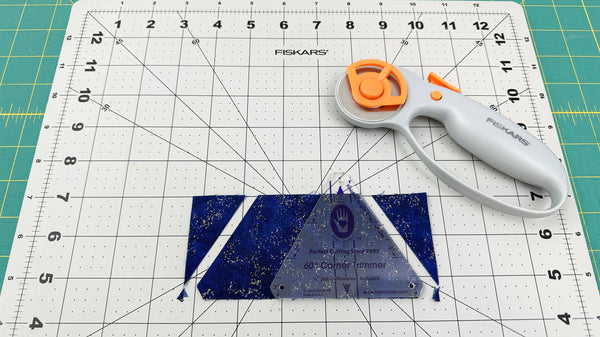
- A rotating cutting mat (I love the Fiskars Rotating Self‑Healing Mat) makes trimming corners faster and safer.
Tips for Piecing 60° Shapes
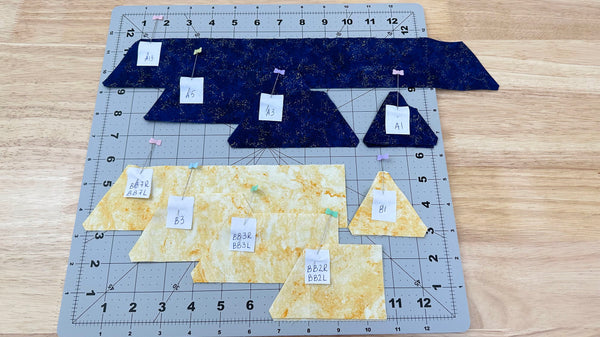
Cut the shapes required for your project and label them as you go. Masking tape, sticky dots, or pinned paper labels all work well. A true ¼″ seam allowance is essential.
Use a patchwork foot and shorten your stitch length to 1.5–1.6 mm. A straight‑stitch needle plate is helpful, but if you don’t have one, use a small scrap of fabric as a leader to prevent puckering.
When sewing 60° shapes, the trimmed corners align perfectly (no dog‑ears), no guesswork. Simply pin, sew from corner to corner with a ¼″ seam, and avoid trimming the sides to prevent distortion.
Assemble your units in the order specified in your pattern, pressing seams carefully for accuracy.

With accurate cutting and consistent seams, you’re ready to use these techniques in your next Jelly Roll project.

- Barnes and Noble
- Indigo
- Amazon (affiliate link)
- Bookshop (affiliate link)
- Books a Million
- Angus & Robertson Australia
- Walmart USA
- Search Press UK